

I was recently sitting in a corporate strategy session when the HR team shared something interesting: they were receiving a surprising amount of negative feedback about their younger employees with confusion on communication styles, job expectations, and questions about motivation.
You could feel a bit of generational head-scratching in the room.
A few days later, I attended the San Diego Meeting Planners International WAVE Forum and heard Nikki Gonzales of Soundings speak about empathy in the workplace and how it can help bridge generational divides. Her perspective was thoughtful, practical, and refreshingly human.
So I decided to ask her a few more questions.
Nikki works in operations for Soundings, a company that connects businesses with talent in marketing and event planning. She has also become something of a Gen Z evangelist for companies trying to better understand their youngest employees.
Her first point? The generational labels might not be as rigid as we think.
Your horiscope doesn’t define you, neither does your generation.
Nikki began by pointing out that generational stereotypes are just that—stereotypes.
“The generations that we have defined are by the years we’re born,” she said. “But in many cases, we can pull characteristics from all the generations as well. It’s mutual respect. No matter what generation you are, everybody’s always looking for that.”
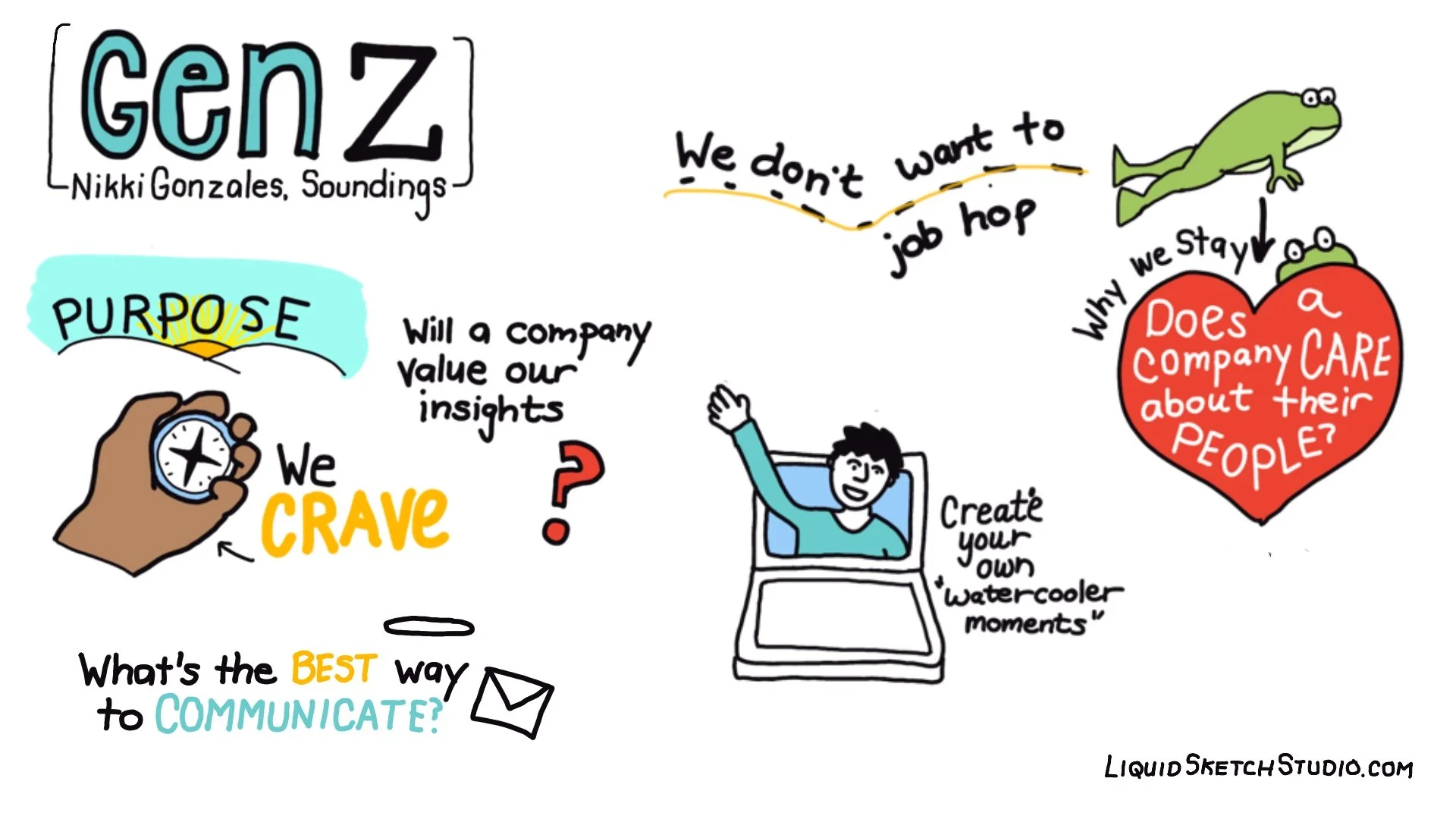
Ask how would the recipient like to receive their information.
Communication expectations can vary widely across teams—and much of that comes down to the tools we use.
“When you’re talking with my peers outside of the work setting, we’re texting and everything’s shorthand,” Nikki said. “Everything is short sentences. Everything is so fast.”
That style sometimes carries into the workplace.
“It’s always the question: how do I send this communication, and through which channel?”
For some colleagues, a quick Slack or Teams message works perfectly. For others, email still signals a more formal request.
“People are more used to seeing requests that are more formal come through email,” Nikki said.
She’s learned to adapt her own communication style accordingly.
“I’ve actually had to adjust sometimes when I’m sending things to different team members. Some people are used to seeing everything in an email formatted a certain way with an attachment. Others are perfectly fine with a quick Teams message.”
Ultimately, it comes back to empathy. “We’re all working on the same projects together. We’re all working on the same team for the same goal. It just might look a little different in how people need to get there.”
Meaning beyond a paycheck.
One consistent theme Nikki sees among her peers is the search for meaning in their work.
“One thing that my generation—I find with a lot of my peers—is that Gen Z is looking for purpose,” she said. “We want to be in organizations that value our opinions, that value our insights, and that will give us longevity.”
She also challenges the common perception that Gen Z employees are eager to jump from job to job.
“I think it’s a misconception that we’ll jump around to different roles just to get to the very top really fast,” she said.
“In many cases, at least from what I’ve seen with my peers, we stay with companies that genuinely care about their people. So I would implore people to put aside any misconceptions of Gen Z being lazy or not wanting to work. We are willing to work and put in the hours—as long as we get that respect back as well.”
Remember your first day at work.
After all, every generation once walked into its first job.
“I think we forget sometimes that Gen Z may be entering their first corporate environment—or their first real-person job—for the very first time,” Nikki said.
That means there will inevitably be a learning curve. “There’s a little bit of grace that we need to remember to give. Give them the space to make mistakes and learn from them.”
For Nikki, some of the biggest professional growth has come from exactly those moments.
“The most growth I’ve had in my career so far has been in the moments where I had to own up to mistakes that I made—and then had the chance to do better.”
Make your own water cooler.
Remote work has added another layer to generational dynamics: how people build relationships when they’re not physically together.
“I feel like it’s a different feeling when you’re in the office and you can just pop into somebody’s cubicle and say hi,” Nikki said. “There’s a level of connection that’s different when everything happens over Zoom or Teams.”
Still, those connections can be created intentionally.
“You create those water-cooler moments by reaching out,” she said. “Schedule a quick coffee chat with someone. Ask how they got here. Ask what their story is.”
Those small conversations help build the same kind of trust that used to happen naturally in office hallways.
Maybe it’s more about communications.
Every generation gets labeled. Every generation gets misunderstood for a while. But Nikki’s advice isn’t really about Gen Z.
It’s about something far simpler—and far harder to practice. A little empathy. A little curiosity. And the willingness to meet people where they are… instead of where we assume they should be.