

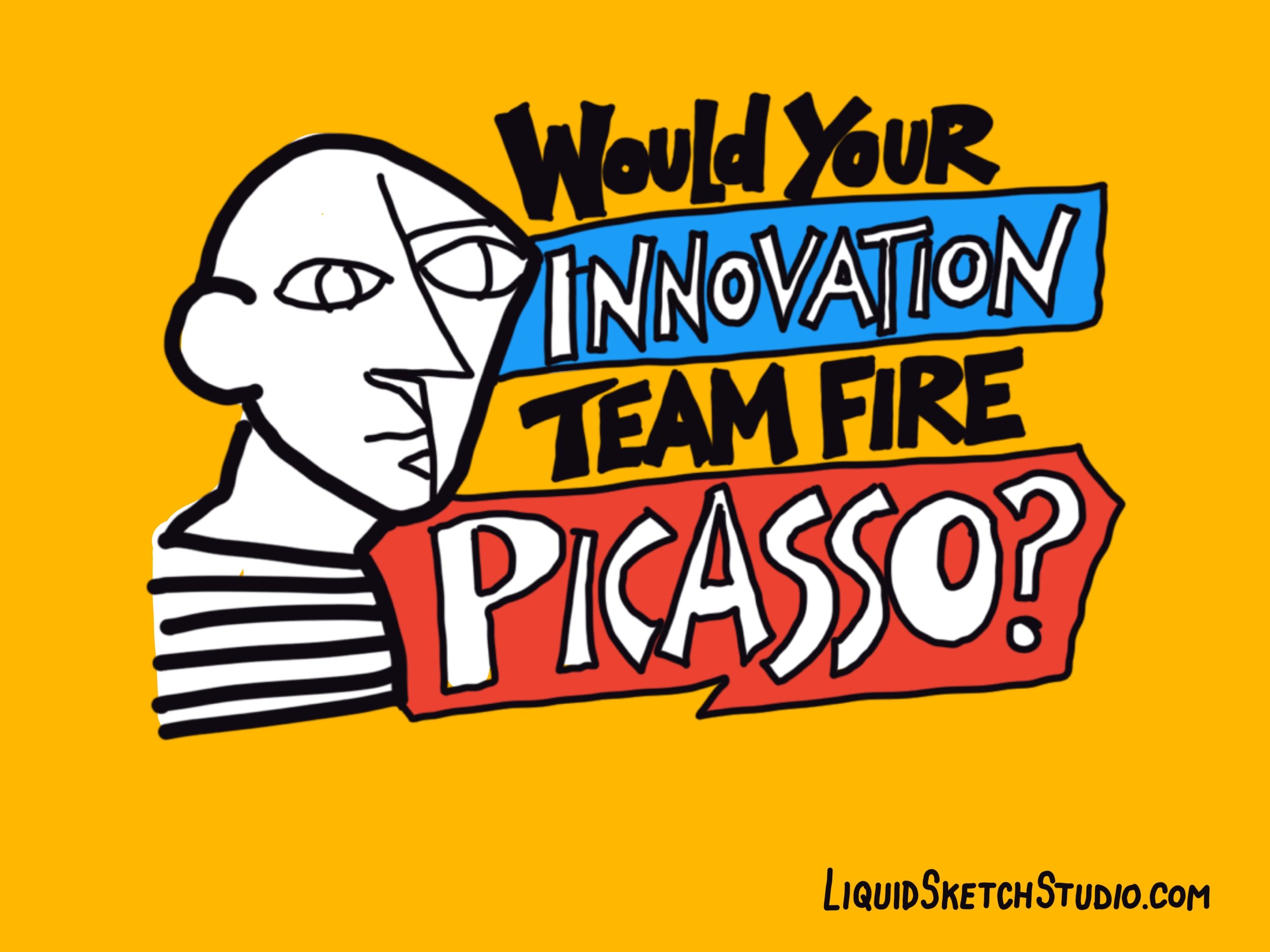
Pablo Picasso would probably get fired from your innovation team. Not because he lacked talent. Because he refused to polish the frame.
I first saw Prashant give a lightning talk on the Opening Night of San Diego Design Week. I graphic recorded his talk and I knew I wanted to talk to him further.
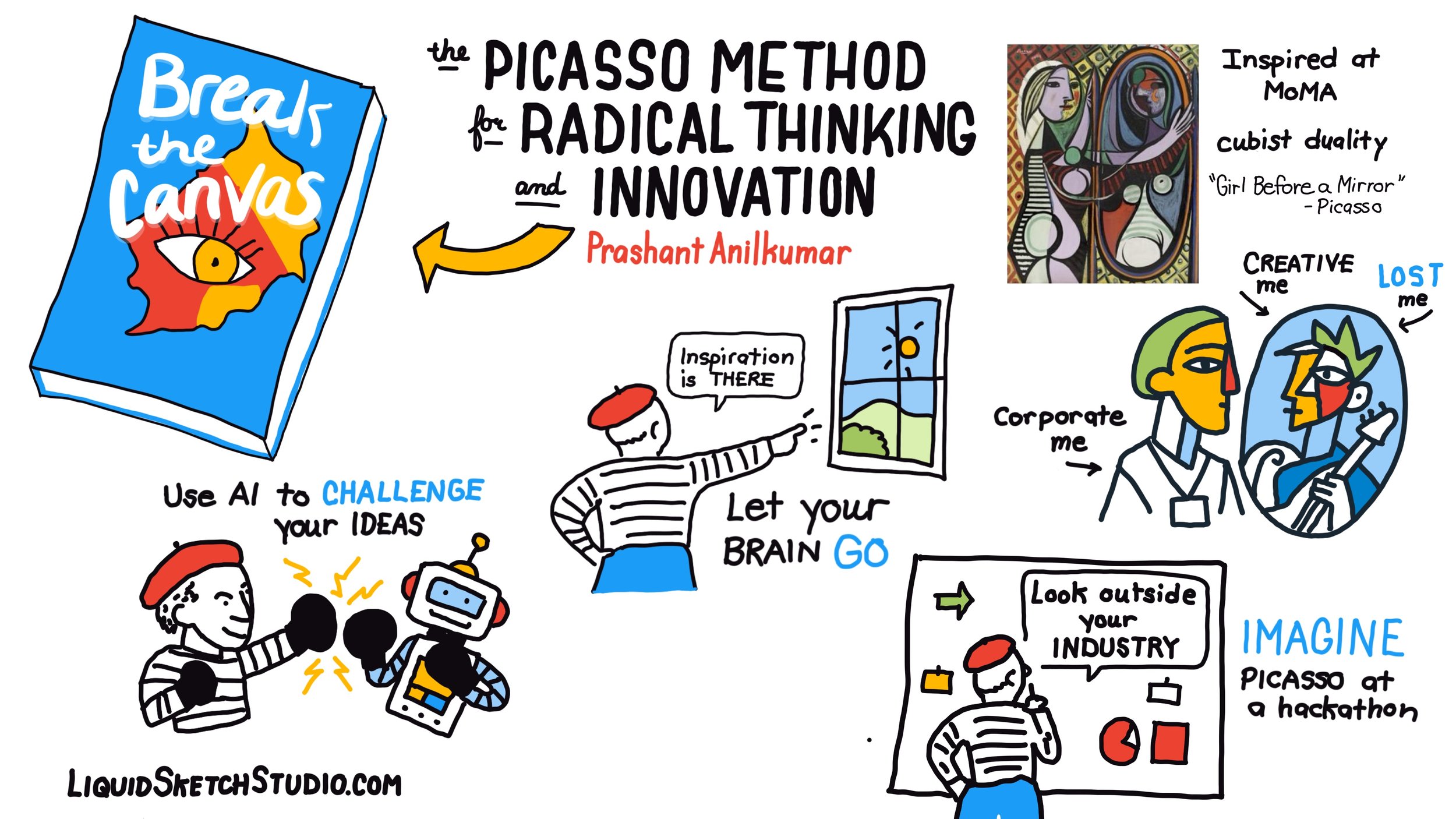
I just sat down with Prashant Anilkumar, author of Break the Canvas: The Picasso Method for Radical Thinking and Innovation. Prashant told me he wrote the book as "a manifesto for anyone with the desire or the mandate or the gumption to just try something different, to build something that doesn't yet exist, that something that doesn't look like anything else that's out there."
What struck me most was his mirror story. He was a tech guy in a corporate badge standing in front of Picasso's Girl Before a Mirror at MoMA. The girl and the reflection don't match. And Prashant saw himself: the Bombay kid with a bass guitar staring back at the man who had learned to optimize instead of create, "You can picture a guy in a proper corporate attire with an ID badge hanging around his neck, standing in front of a mirror, but the reflection is this kid in Bombay with a bass guitar around his neck."
That duality is the whole point. Innovation doesn't come from becoming more professional. It comes from letting the parts of yourself you buried back into the room.
Then he dropped the line that made me lean forward: "Ideas are never the problem." We have been taught to believe there's an idea shortage, so we run brainstorms and hackathons and innovation sprints. But Prashant's take is that ideas are everywhere. They just get "suppressed or sanitized or discarded, just to fit the frame that exists." The real work isn't generating more ideas. It's breaking the canvas. "We need to question what the mold is in whatever industry or domain you're in and then try to break it."
And how would Picasso react to AI? Prashant said Picasso would be "both mesmerized and mortified. He'd tell you to confuse it, contort it, and ask it the same thing 100 different ways. But he'd never be satisfied with the answers because it gives you exactly what you're looking for. That's the worst thing." The magic is in the clash and collision that produces something that didn't exist before.
Prashant even turned his book cover into the argument. Most business book covers are sterile. His cover is a canvas shattering, with an eye that looks both at you and to the side, multiple perspectives at once. The product became the point of view.
And sometime we just have to leave our data-driven-productivity schedule behind: Let your mind go. Picasso would stop mid-painting, grab a drink, argue about politics, do something mindless. Then he'd come back and see the portrait differently. Prashant called it the default mode network: "A focused mind is a spotlight, and then the default mode network is the sun." We pack our days so full of efficient work that we leave no room for the unconscious connections that actually produce breakthroughs.
Check out Prashant's book at BreakThe Canvas or on Amazon.