

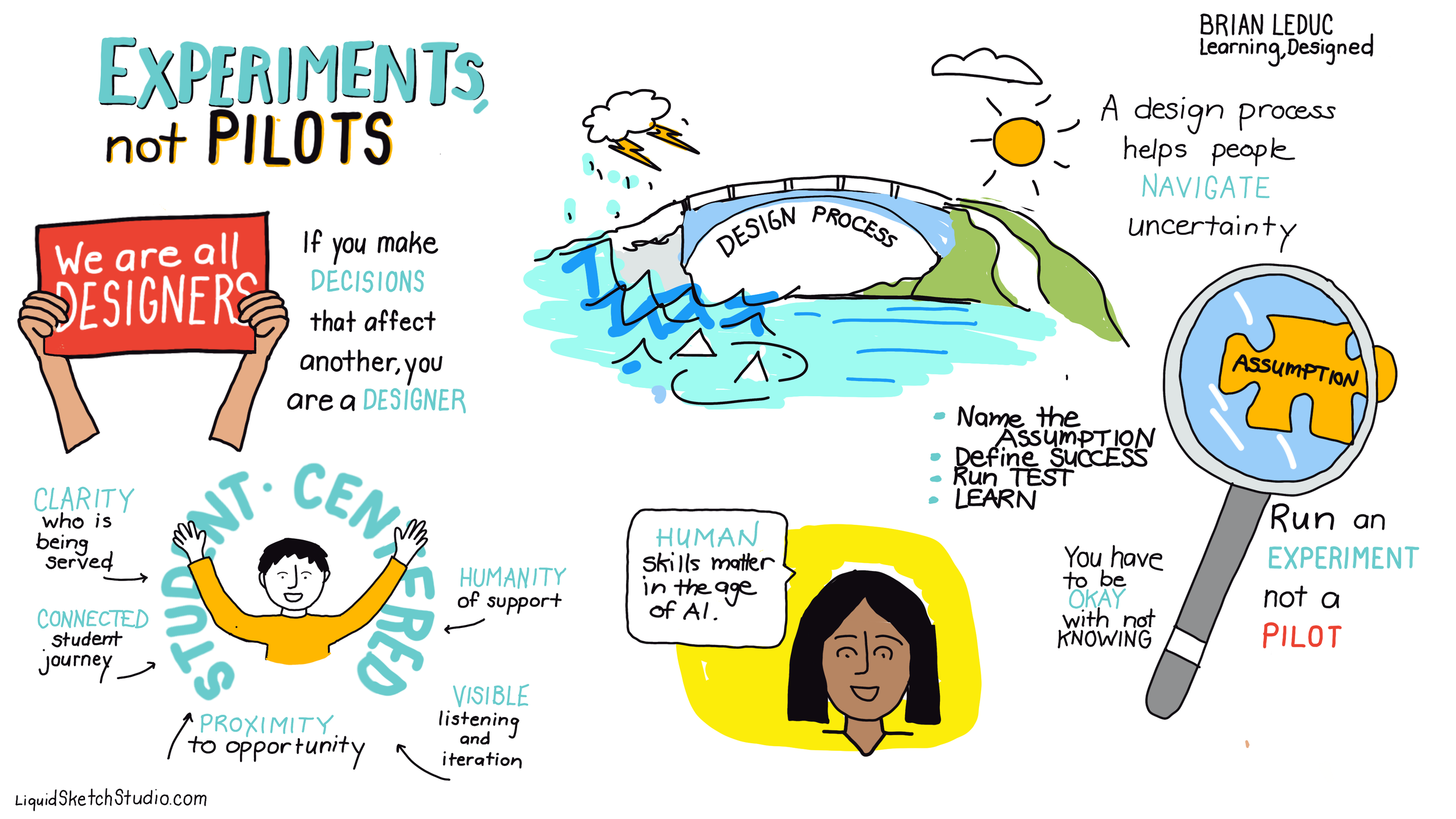
How design helps institutions move forward without pretending they already know the answer
A pilot sounds responsible.
Take the big idea, shrink it down, try it with fewer people and see what happens.
Smaller risk. Smaller investment. Sounds smart, right?
Not necessarily.
In my recent conversation with Brian LeDuc, founder and chief design strategist at Learning, Designed, we explored how educational institutions can use design to create more human, student-centered experiences.
One of Brian’s most compelling recommendations was deceptively simple: “Rather than run a pilot, let’s go run an experiment.”
The problem with pilots
Institutions love pilots because they feel safe.
“When we organize a pilot, it’s a small-scale version of a full thing that we want to build,” Brian explains. “So instead of doing it for 1,000 people, we’re just going to do it for 10 or for 50.”
The problem is that even the smaller version may contain dozens of untested assumptions.
“When you just build the whole thing for 10 or for 50, you’ve embedded all of those assumptions inside of the way that you’ve created what that experience is,” Brian says.
Everything gets bundled together. If the pilot succeeds, you may not know which part made it work. If it fails, you may not know which assumption was wrong.
“It’s really hard to decipher what was the thing that either worked really well about it or didn’t really work well about it,” he adds.
An experiment asks a smaller question and tests one specific assumption.
“Let’s go test something that’s very specific and very small,” says Brian. Doing that well requires the discipline to ask, “What does success look like?”
Instead of creating a four-week program for 50 students, an institution might begin with a one-page description and a sign-up link.
That small interaction tests one important assumption: Do people want this?
Only then do you move to the next question.
The courage not to know
“Education is largely a system that’s built on answers,” Brian explains. People “ascend in the educational ranks” by earning terminal degrees, developing expertise and, as he puts it, “literally bringing answers to the field.”
Design asks those experts to become comfortable with not knowing the answer yet.
“The idea that you would start down a path and not know what the outcome is going to be” can be deeply uncomfortable, Brian reflects, whether you are investigating a problem or testing a possible solution.
Starting anyway requires what he describes as courage, boldness and humility.
A process provides stability in uncertain times
Not knowing the answer does not mean operating without direction. Design provides a process.
In today’s uncertain world, people often feel anxious, stressed, and overwhelmed. A dependable process gives them somewhere to focus their energy.
“The what can change, but the how, if there’s some stability and focus for that, gives people some comfort and clarity,” Brian says.
The process does not eliminate uncertainty. It gives people a way to move through it.
We are all designers
Design is not limited to people with the word designer in their job title.
“We’re all designers,” says Brian. “When we make choices that affect other people, we’re designing.”
That means every enrollment form, advising conversation, course structure and technology handoff shapes someone else’s experience.
The question is not whether institutions are designing. The question is whether they are doing it intentionally.
Five parts of a student-centered experience
Calling an institution student-centered does not make it so.
Student-centeredness is revealed through the decisions that shape how students move through the institution. Brian identifies five essential elements.
1. Clarity about whom you serve
Institutions need to be explicit about whom each program or experience is designed to serve.
Too often, Brian says, programs are vaguely intended for “everyone.” Without a clear audience, it becomes difficult to understand students’ needs or create an experience that responds to them.
2. Coherence across the student journey
Students experience the university as one institution, even when it operates as disconnected departments.
Advising, admissions, orientation, residence life and academic programs need to work together so students are not forced to carry information between systems that do not communicate.
3. Proximity to students’ goals
Students need to understand how their education connects to the future they are working toward.
Brian calls this “proximity to opportunity.” It does not mean removing every challenge. But students should be able to see how that struggle connects to their goals, opportunities and life after college.
4. Evidence of listening and iteration
“Feedback isn’t a box by the door” that no one is sure gets checked, Brian says. It should be an active part of the institution’s relationship with students.
That means talking with students, noticing unnecessary friction and showing them ideas while those ideas are still works in progress. Students should be able to see how their participation helped shape the final experience.
5. The humanity of support
Universities need to use technology thoughtfully. But students also need encouragement, mentorship, advice and connection.
Brian describes this as the “humanity of support.” If universities begin to look more like call centers, he warns, they risk losing the relationships that make education a process of “humans developing humans.”
As more technology and AI make their way into the educational environment, the very things that make us human become more important: creative problem-solving, creativity, flexibility, adaptability, resilience, and empathy.
Watch my full sketchcast with Brian LeDuc to hear more about design, student-centered institutions, human connection, and the skills universities will need to cultivate in an AI-enabled world.
Follow Brian’s work and subscribe to his newsletter at:
https://brianfleduc.beehiiv.com/
You can subscribe to Anne’s newsletter: Making Vision Visible: How Leaders Close the Gap from the Big Idea to Actual Moves