

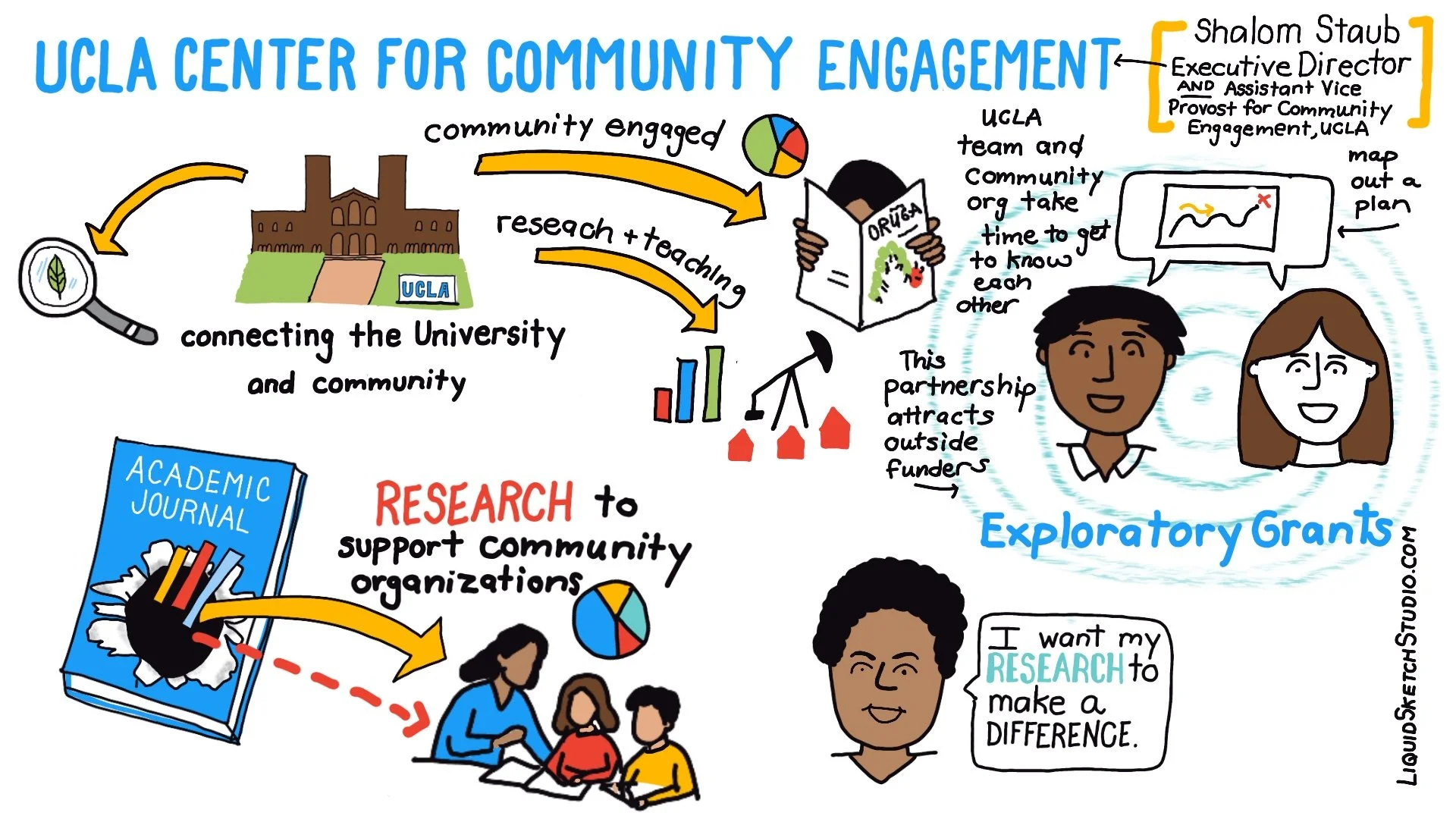
How can a university offer its resources to create meaningful change in the surrounding community?
I had the pleasure of visually scribing the Summit for Community Engagement, hosted by the UCLA Center for Community Engagement. The summit brought UCLA faculty, staff, students, and local community organizations into the same room to explore how academic resources could support real needs across Los Angeles.
I recently sat down with Shalom Staub, Assistant Vice Provost for Community Engagement and Executive Director of the UCLA Center for Community Engagement, to discuss the ways the university is pioneering new forms of community collaboration.
Traditionally, the Center for Community Engagement has concentrated on teaching and learning. However, its mission has recently expanded to include community-engaged research. In simple terms, community-engaged research means research done with community partners, not merely about them.
Staub explains, “We have branched out to be an advocate and catalyst for supporting community-engaged research and connecting faculty and students to community partners for mutually beneficial, reciprocal, values-based research.”
Out of the Classroom and Into the Community
Community collaboration is a key pillar of UCLA’s approach.
“UCLA has a very broad and deep network of engagement with the broader community...both undergrads and graduate students have internships and professional placements,” Staub says.
These engagements ensure that volunteer work and classroom study align, creating valuable learning opportunities for students and tangible benefits for community partners.
Community-engaged courses are a testament to this philosophy. These specially designed courses enable students to study specific topics while actively working in community settings.
As Staub puts it, “The volunteer work experience and the study in the classroom connect, and it creates learning opportunities for the students and also tangible benefits for the community partner organization.”
Research for the Community, Not Just for Academic Peers
Faculty want to see their research make a difference in their community.
For many, that means moving beyond the traditional academic model of publishing research primarily for other academics. UCLA attracts faculty who want their work to resonate beyond academic circles and create real-world impact.
“There are faculty who are interested in moving away from a solely academic focus of research,” Staub says. “UCLA really is attracting faculty who say, okay, my traditional academic research is fine. But I also want to be doing research that makes a difference, and they want to do this by connecting with community organizations.”
Sometimes that connection comes from a faculty member’s own identity or background. Other times, it comes from a specific issue they care deeply about.
“It has to do with an issue that they care passionately about,” Staub says.
Planting Seeds for Successful Partnerships
Of course, universities and community organizations often work on different timelines.
“Community organizations and community leaders are concerned about the here and now,” says Staub. “What’s going to make a difference for the constituents that I serve? And faculty are still committed to rigorous academic quality and have a strong interest in the quality of their research design. And so often their timeline may take longer than an immediate need.”
To help bridge the cultures of community organizations and academic research, UCLA created the Social Impact Collaboratives Program. The program gives UCLA researchers and community organizations time, structure, and funding to build trust before launching a larger research project.
The program connects interdisciplinary teams of UCLA researchers with community partners around topics of social inequality in Los Angeles, with the goal of supporting future research that contributes to positive social impact.
“The first thing we did was fund what we call the exploratory grants,” says Staub. “And in the exploratory grants, it was a $10,000 grant to enable the interdisciplinary research team and the community partners to spend a year getting to know one another, getting to know each other’s language, getting to know each other’s priorities, understanding what each of them brought to the relationship, and what we asked of that team, that social impact collaborative, was to develop what we called a theory of change.”
That time spent building trust is essential.
“What we saw was that they spent time bridging those two cultures and learning what it takes to create a mutually respectful, equitable partnership, where the university doesn’t hold the power, but the power is shared between university and community partners,” says Staub. “And in fact, community members can be researchers. So it’s really building a new paradigm, a new model for university-community research collaboration.”
Building Trust Before Building Research
Taking the time for organizations and researchers to get to know one another has paid off.
“I’ve had faculty tell me that the most important thing they’ve done to establish the quality of a future research partnership is spending time volunteering at the community organization,” says Staub. “Not to be the outsider who has all the research credentials, but to be there in the trenches and see what that organization is seeing on a day-to-day basis as it works with its community constituents.”
The goal of the Social Impact Collaboratives was to stimulate new work, particularly by new faculty who had not yet done this kind of community-engaged research.
“Over the past two years, we used internal funding as a kind of stimulus program,” says Staub. “And those grantees are now in the process of building on the work that we funded and beginning to go to external funders to say, ‘Hey, UCLA helped stimulate the initial stages of this research. But to continue this research, we’re now turning to private foundations and governmental agencies at the state level and at the federal level to support this at a higher level.’”
In this way, UCLA’s internal funding acts as an initial push, helping researchers and community partners build the foundation they need to pursue larger funding opportunities and longer-term impact.
A Partnership with Purpose
The collaboration between UCLA and Los Angeles communities demonstrates the power of intentional, impactful partnerships.
Because when universities and communities take the time to learn each other’s language, research can move beyond the page and into the places where it can actually make a difference.